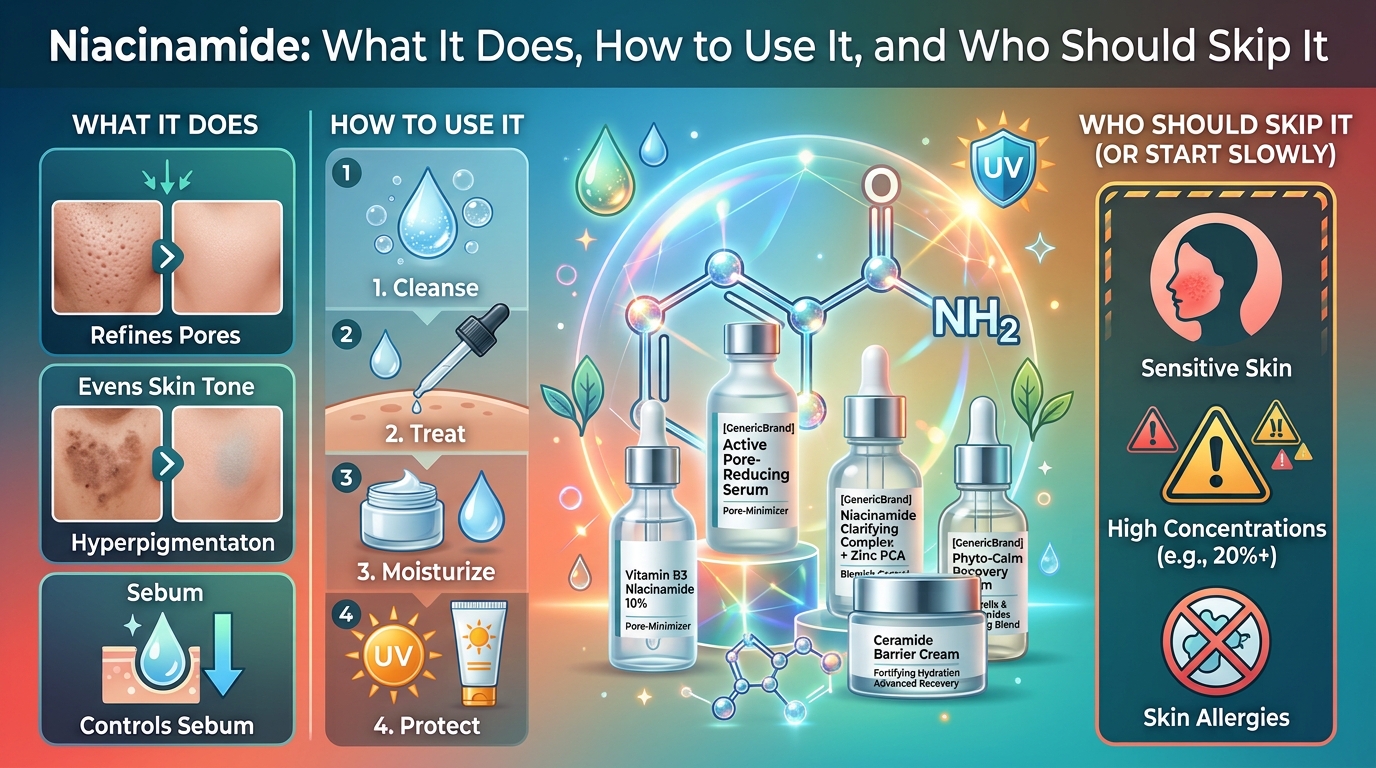
Niacinamide: What It Does, How to Use It, and Who Should Skip It
If you have scrolled through skincare posts lately, you have definitely seen one ingredient everywhere: niacinamide. It is in serums, moisturizers, cleansers, even sunscreens. Brands put it on the front of the bottle like a badge of honour — so it is fair to ask: does it actually do anything, or is it just good marketing?
Let’s be real — niacinamide is one of the few trendy ingredients that genuinely deserves most of its good reputation. It is gentle, it works for many skin types, and dermatologists have recommended it for years. But it is not magic, it does not work overnight, and it is not right for absolutely everyone.
In this guide, we will keep it simple and honest: what niacinamide is, what it may help with, how much you really need, how to use it step by step, and who should skip it.
What is niacinamide?
Niacinamide (you may also see it called nicotinamide) is a form of vitamin B3, one of the eight B vitamins. Your body uses vitamin B3 for everyday health, but in skincare we are talking about the topical version — the kind you apply to your skin in a serum, cream or moisturizer.
You will find it in all kinds of products: serums are the most popular, but it also appears in moisturizers, toners, face masks and some sunscreens. Because it is water-based and generally well tolerated, it slips easily into almost any routine — which is a big reason it has become so popular.
What niacinamide may help with
Niacinamide is a true multitasker. Here is what it is known for — with honest wording, because no single ingredient can do everything.
1. It supports your skin barrier
Your skin barrier is the thin layer of water and oil that keeps moisture in and irritants out. Niacinamide may help that barrier work better, so skin holds onto hydration and feels less sensitive. When your barrier is struggling, skin often looks dry, red and reactive — so a stronger barrier is the quiet foundation of almost every other benefit on this list.
2. It can calm redness
Niacinamide has been shown to ease inflammation, which may help calm the look of redness linked to breakouts, rosacea-type flushing or eczema-prone skin. It can also soothe skin that feels irritated by stronger exfoliating ingredients like retinol or glycolic acid.
3. It helps balance oil
If your T-zone is shiny by lunchtime, this one is for you. Niacinamide may help regulate how much oil your glands produce, which can mean fewer clogged pores and less midday shine. It does this gently — it does not strip or dry the skin the way harsh acne products can.
4. Pores may look smaller
Honest moment: nothing has been proven to shrink your actual pore size — pores do not open and close like doors. But by supporting the barrier, improving elasticity and keeping pores clearer, niacinamide can make pores look less noticeable and skin look smoother overall.
5. It may help fade dark spots
Niacinamide is a dermatologist-approved ingredient for brightening skin tone, and some research suggests that formulas with 5% niacinamide can help lighten dark spots and even out patchy areas, such as the marks left behind after a breakout. It is a slow, steady kind of brightening — not a bleach, and not instant.
6. Fine lines may look softer
Thanks to its antioxidant properties, niacinamide may help skin recover from everyday stress from sun, age and pollution. Used consistently, it may improve the appearance of fine lines and wrinkles and help skin look firmer and more hydrated — well-hydrated skin naturally looks plumper, which softens how lines appear.
How much niacinamide do you actually need?
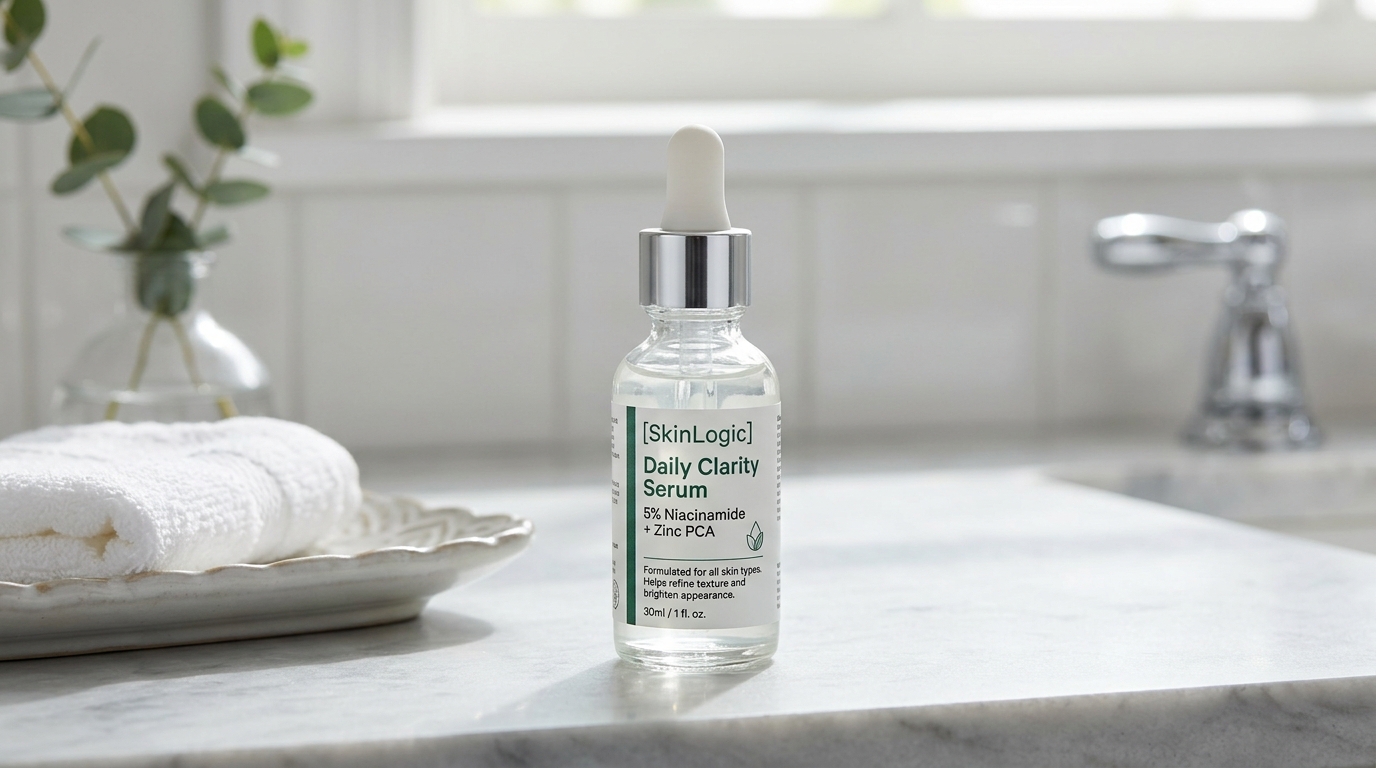
Here is where marketing tries to trick you. Serums shouting “10%!” or even “20%!” look stronger, so they sell better. But most skincare products contain 5% niacinamide or less, and most of the research behind this ingredient was done at gentle strengths — around 2% to 5%. A dermatologist at Baylor College of Medicine recommends using niacinamide at a concentration of less than 5% for concerns like acne-related inflammation, signs of aging and dark spots.
The simple takeaway: more is not automatically better. A very high percentage mainly raises your chance of stinging, flushing or irritation, especially if your skin is sensitive.
| Strength | Who it suits | Good to know |
| 2% or less | Very sensitive skin, total beginners | A gentle starting point; often found inside moisturizers |
| Around 5% | Most people, most goals | The range most research is based on, including dark-spot studies |
| 10% or more | Skin that already tolerates it well | Not proven to work better than 5%; more likely to irritate sensitive skin |
If you are new to niacinamide, start low, use it once a day, and only increase how often you use it once your skin is clearly happy.
How to use niacinamide, step by step
- Cleanse. Wash your face with a gentle cleanser and pat dry.
- Tone (optional). If you use a toner, apply it now and let it sink in for a moment.
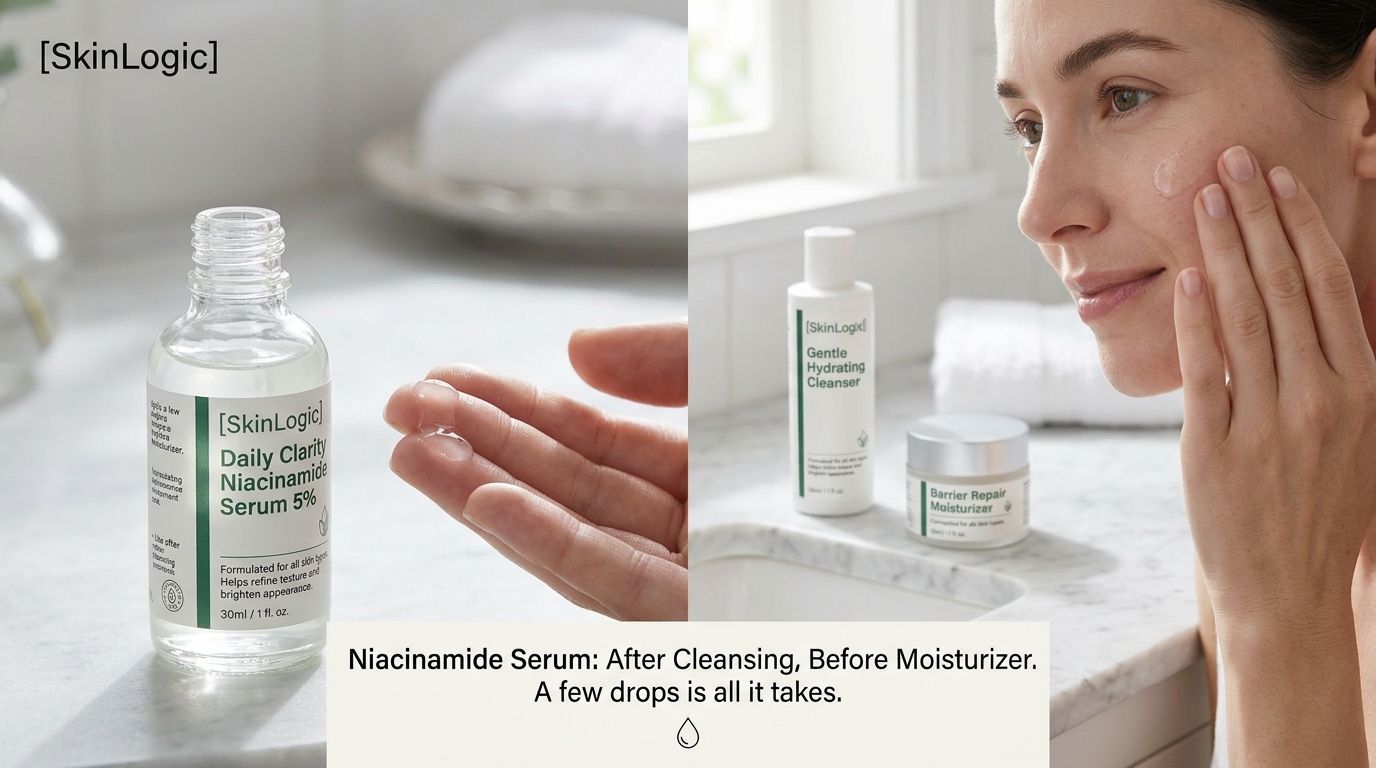
- Apply niacinamide. Smooth a pea-sized amount (or 2–3 drops of serum) over your face and neck. If your niacinamide is inside your moisturizer, you can skip a separate serum.
- Moisturize. Seal it in. In the morning, finish with sunscreen; at night, this is your last step unless you use a richer night cream.
Niacinamide can be used once or twice a day, morning or night — it is not sun-sensitive, so the timing is flexible. The golden rule of layering still applies: apply products from thinnest to thickest.
| Morning routine | Evening routine | |
| Step 1 | Gentle cleanser | Gentle cleanser |
| Step 2 | Niacinamide serum | Niacinamide serum (or your retinol, on alternate nights) |
| Step 3 | Moisturizer | Moisturizer |
| Step 4 | Sunscreen (SPF 30 or higher) | — |
What niacinamide pairs well with
One of niacinamide’s best qualities is that it plays nicely with others. It is commonly paired with:
- Hyaluronic acid — a classic hydrator that draws water into the skin
- Vitamin C and other antioxidants — help protect skin and support a brighter tone
- Retinol — a friendly partner; niacinamide’s calming effect can make retinol easier to tolerate
- Ceramides in moisturizers — support the skin barrier alongside niacinamide
- Glycolic acid — an exfoliating acid niacinamide is often combined with in anti-aging formulas
One caution: because niacinamide is in so many products now, it is easy to accidentally use it in your cleanser, serum and moisturizer all at once. More layers do not mean more results — pick one main niacinamide product and keep the rest of your routine simple.
Side effects: what to watch for
Niacinamide is generally considered gentle and safe, and side effects are rare. When they do happen, they are usually mild:
- Itching
- A mild burning or stinging feeling
- Redness
- An allergic reaction (uncommon)
Before using any new product all over your face, do a patch test: apply a small amount on your forearm and wait 24 hours. If your skin stays calm, you are good to go. If a product burns, stings or leaves you red every time you use it, stop using it — skincare should never hurt.
Who should skip niacinamide?
Most people can use niacinamide happily. But “most” is not “all”. Skip it — or talk to a dermatologist first — if any of these sound like you:
- Your skin reacts to it — even at low strengths during a patch test. There are plenty of other barrier-friendly ingredients; this one is not compulsory.
- You have a skin condition that needs real treatment, such as ongoing eczema, rosacea or stubborn acne. Niacinamide can support skin alongside treatment, but it is not a treatment itself, and a dermatologist can tell you what your skin actually needs.
- You are on prescription skincare, for example after a procedure, or while using prescription products. Ask your doctor before adding new active ingredients.
- You are pregnant, breastfeeding, or simply unsure. Topical niacinamide is widely used, but your own doctor knows your situation and should have the final say.
And one honest note for everyone: if your main goal is deep acne scarring or a medical skin concern, a serum alone will not fix it — that is a job for a professional, and there is no shame in that.
4 common niacinamide mistakes
- Chasing the highest percentage. As we covered above, 10–20% is not proven better than 5% — it is just more likely to irritate.
- Expecting overnight results. Dark spots and fine lines change slowly. Give any new product several weeks of consistent use before you judge it.
- Skipping sunscreen. Brightening ingredients cannot do their job if new sun damage keeps arriving. Daily sunscreen is what protects your progress.
- Introducing five new products at once. Starting niacinamide, retinol and two acids in the same week is how barriers get damaged. Add one new product at a time.
Frequently asked questions
Can I use niacinamide every day?
Yes — for most people, once or twice a day is fine. If your skin is sensitive, start once a day (or every other day) at a low strength and build up slowly.
Can I use niacinamide with retinol?
Yes. They are a popular pair: retinol does the heavy lifting on texture and fine lines, while niacinamide helps keep skin calm and supported. Many people use niacinamide in the morning and retinol at night, or layer niacinamide before retinol at night.
Can I use niacinamide with vitamin C?
Yes. Niacinamide is often paired with vitamin C and other antioxidants in brightening routines and formulas. If your skin is very reactive, use one in the morning and the other at night while your skin adjusts.
How long does niacinamide take to work?
Give it time. Calmer, better-hydrated skin may show up fairly soon, but dark spots and fine lines change gradually over weeks of consistent use. Take a photo in the same light every couple of weeks — slow progress is much easier to see that way.
Does niacinamide shrink pores?
Not permanently — nothing has been proven to change your actual pore size. But by balancing oil, keeping pores clearer and supporting elasticity, niacinamide can make pores look smaller and less noticeable.
Is niacinamide good for sensitive skin?
It is one of the gentler active ingredients and suits most skin types, including sensitive skin. Start with a low strength (2% or less inside a moisturizer is a soft landing), patch test first, and stop if your skin protests.
The bottom line
Niacinamide earns its popularity: it supports your skin barrier, may calm redness, helps balance oil, and can gradually brighten dark spots and soften the look of fine lines — all while being one of the gentlest actives you can buy. Keep it simple: choose one product at around 2–5%, use it consistently after cleansing and before moisturizer, wear sunscreen in the day, and give it a few weeks before you decide. And if your skin says no, listen to it — there is always another ingredient.
Have you tried niacinamide? Tell us in the comments what strength worked for your skin — your experience may help another reader.
Sources
- Cleveland Clinic — Benefits of Niacinamide
- Baylor College of Medicine — From serum to supplement: How niacinamide supports healthier skin
Disclaimer: This article is general skincare information only and is not medical advice. If you have a skin condition or a concern that does not improve, please see a dermatologist.